
'While salary increments are moderating compared to last year, not all functions are moving at the same pace.'

A new study predicts a 55 per cent surge in drone deployment across India's logistics and clean tech sectors over the next three years, driven by rapid digitalisation and the need for faster, more sustainable solutions. The Indian logistics market is projected to nearly double to USD 428.7 billion by 2033, highlighting a significant transformation in these key industries.

From online abuse targeting cricketers' families to paid hate campaigns and bot-driven fan wars, cricket's social media ecosystem has spiraled into a toxic industry driven by outrage, algorithms and commercial interests.

Indian companies are increasingly opting for demergers, with 29 deals valued at over $40 billion in 2025 alone, marking a 10-year high, as promoters and boards recognise that markets favour focused businesses over complex conglomerates.

Non-resident Indians (NRIs) in the Gulf region are increasingly purchasing term life insurance policies from India, driven by geopolitical uncertainties in West Asia and the significant cost advantages offered by Indian products, with the GCC region now contributing over half of the total NRI demand.
India's industrial production growth decelerated to a five-month low of 4.1 per cent in March, primarily due to the subdued performance of the manufacturing and power sectors, exacerbated by the West Asia crisis.

Corporate India is projected to offer salary increments ranging from 8.6 per cent to 10.2 per cent across various industries in the financial year 2026-27, primarily fuelled by a sustained demand for skilled and execution-focused talent, according to a TeamLease Services report.

Hindustan Zinc Ltd (HZL) plans to generate 2,000 crore in value by implementing artificial intelligence-driven solutions across its mining and manufacturing operations. This initiative is part of a broader industry trend to adopt digital technologies for cost reduction, margin improvement, and enhanced environmental and social governance.

Companies are investing heavily in complex injectables, respiratory therapies and biosimilars to improve margins and diversify portfolios.

Indian benchmark indices Sensex and Nifty climbed in early trade, driven by buying in blue-chip stocks like Reliance Industries and ICICI Bank, alongside a notable cooling in crude oil prices.

Indian liquor brands are increasingly focusing on Hindi heartland states like Uttar Pradesh, Rajasthan, and Haryana as the next major growth engine for premiumisation, driven by expanding luxury portfolios, craft spirit launches, and upgraded retail experiences, as state governments embrace reforms.

Indian benchmark indices Sensex and Nifty rallied in early trade, driven by a positive trend in global markets, cooling crude oil prices following a US-Iran peace deal, and fresh foreign fund inflows.

Rebel Shiv Sena-Uddhav Balasaheb Thackeray MP Omprakash Rajenimbalkar has justified his crossover to the ruling Shiv Sena, saying if the people are gravitating towards power, he is merely following the trend.

World Cup 2026 is on track to become the biggest betting event in history, with global wagers expected to exceed $50 billion as sportsbooks report record-breaking activity driven by the expanded tournament format and growing legal gambling markets.

A new report reveals a significant shift in India's AI hiring landscape, moving from experimental roles to those focused on deployment, integration, and scaling of AI solutions. Employers, including GCCs, IT services, and enterprises, are increasingly seeking professionals who can implement AI across core business operations, leading to a demand for core AI roles that currently outstrips the available supply.
Indian benchmark stock indices, Sensex and Nifty, extended their winning streak for a third consecutive day, driven by positive global market trends and a significant softening of crude oil prices following a peace deal between the US and Iran.

The Indian equity market is set for an event-heavy week, with analysts pointing to the Reserve Bank of India's (RBI) interest rate decision, developments in the US-Iran situation, and crude oil prices as the primary determinants of market trends.

'We may be able to wind back some of the schedule reductions we'd taken in recent months.'

Domestic cooking gas (LPG) prices have increased by Rs 29 per cylinder, marking the second hike in three months due to rising global energy costs. This follows broader fuel price increases for petrol, diesel, and CNG, with state-owned retailers still incurring significant losses despite the revisions.

Net mutual fund inflows into active equity schemes in India plummeted by 40 per cent month-on-month in May, reaching a one-year low of 22,908 crore, primarily due to weaker lump-sum investments and increased redemptions amidst significant market volatility and global uncertainties.

'Can you believe there are over 26,500 deaths linked to heatwave-driven ozone in 2024?'

The start of the West Asia conflict has led to a sharp increase in crude-linked raw material prices, pushing up the price of helmets across the country.

Ola Electric is experiencing a significant rebound in the June quarter, with vehicle registrations in Q1 FY27 already exceeding the total registrations for Q4 FY26, indicating a strong recovery in demand.

Listed capital market companies in India delivered strong fourth-quarter earnings growth, with a universe of 12 firms posting 30 per cent year-on-year revenue growth and 19 per cent earnings growth in Q4FY26, despite mark-to-market (MTM) losses impacting headline profitability for some.

Somewhere between couture and chaos, the Met Gala 2026 decided subtlety was overrated.

The Union Ministry of Home Affairs has formed a High-Level Committee on Demographic Changes to study the impact of illegal immigration and other factors on India's demographic landscape.

The Congress party has accused Home Minister Amit Shah of launching an "onslaught" on the Opposition and "wrecking" Indian democracy. The party alleges that Shah is enticing elected representatives to join the BJP with significant incentives, a claim echoed by Shiv Sena (UBT) leader Sanjay Raut regarding Maharashtra MPs. This comes amidst reports of defections from other parties like the TMC.

The SIF vertical, which allows MFs to offer complex products to relatively sophisticated investors, has managed to garner scale in just seven months of the launch of the first products.

'There has to be a safe harbour for licensed entities, which have followed all the norms prescribed by the RBI.'

Mercedes-Benz India is exploring a larger role for plug-in hybrid electric vehicles (PHEVs) in its portfolio, with plans to potentially introduce the technology in more models beyond the newly launched S-Class plug-in hybrid. This strategy aims to cater to luxury car buyers who are hesitant about fully electric vehicles due to concerns over charging infrastructure and range.

Indian benchmark indices Sensex and Nifty experienced a significant slump, with the Sensex tumbling 719.08 points, driven by escalating West Asian tensions, a sharp rise in crude oil prices, and a global sell-off in technology stocks.

Despite reporting a weaker-than-expected net loss of Rs 2,536 crore for Q4FY26, largely due to a significant non-cash forex loss, analysts remain optimistic about IndiGo's long-term prospects, citing strong demand trends, a favourable pricing outlook, and strategic cost-control measures.

The asymmetry in deposit and credit growth is the biggest challenge before the Indian banking industry. For every 100 deposit that a bank mobilises, it needs to keep 3 with the banking regulator in the form of cash reserve ratio on which it doesn't earn any interest. Another 18 is used for buying government bonds (statutory liquidity ratio). This means, a bank is left with 79 for giving credit. Add to this, its capital which can be used for giving loans. Most banks are facing a fund crunch. They need to find ways to attract deposits if they want to sustain credit growth, explains Tamal Bandyopadhyay.

India's mutual fund industry has significantly increased its share of public trading in the stock market, widening its lead over the Life Insurance Corporation of India (LIC) for the fifth consecutive year. While LIC's share of free-float listed shares has fallen to 7.42% as of March 2026, the mutual fund industry's share has surged to 22.92% from 7.06% in 2012.

Indian benchmark indices Sensex and Nifty traded lower amid volatile trends, influenced by escalating geopolitical uncertainties in West Asia and fresh outflows from Foreign Institutional Investors (FIIs).

'India has initiated a bear market and we will still go lower. It has nothing to do with the economy.'

West Bengal BJP president Samik Bhattacharya has expressed the state government's desire for the Tata Group to return to Singur, viewing it as an economic necessity and a signal that West Bengal is open for business. The move aims to reverse the negative perception created when the Nano project was forced out of the state.
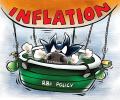
The Reserve Bank of India has increased its retail inflation projection for 2026-27 to 5.1 per cent, up from an earlier estimate of 4.6 per cent. This revision is primarily attributed to mounting input costs, driven by the pass-through of higher global energy prices to domestic petrol and diesel rates, which have seen significant increases since May.
Indian benchmark indices Sensex and Nifty closed lower for the second consecutive day, driven by investor caution over conflicting geopolitical signals from West Asia and fresh foreign institutional investor (FII) outflows.

Indian cement manufacturers, despite a stable Q4FY26, are bracing for significant profitability pressures from Q1FY27 onwards due to escalating input costs, primarily driven by the West Asia conflict's impact on coal and petcoke prices.
